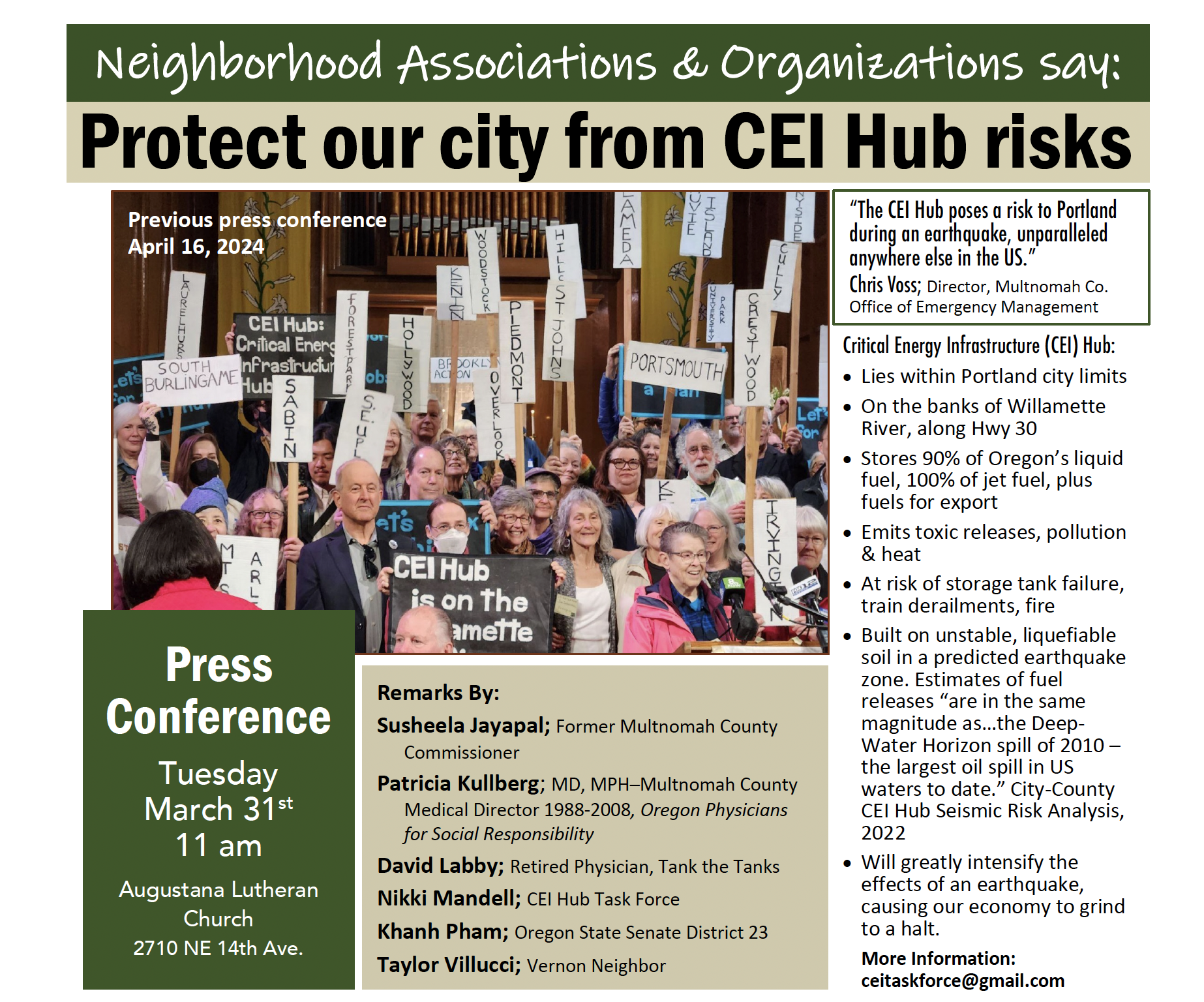
Critical Energy Infrastructure (CEI) Hub
Explore the history of the CEI Hub, and the impacts and risks it presents for Kenton.
Background on the CEI Hub
The Kenton Neighborhood is located near two major railroad freight routes. Many trains are composed of multiple tanker cars carrying oil and chemicals to the Critical Energy Infrastructure (CEI) Hub, a six mile industrial zone along the Willamette River with approximately 630 aging storage tanks. These facilities are built on unstable soil that is subject to liquefaction when the predicted Cascadia Subduction Zone earthquake arrives.
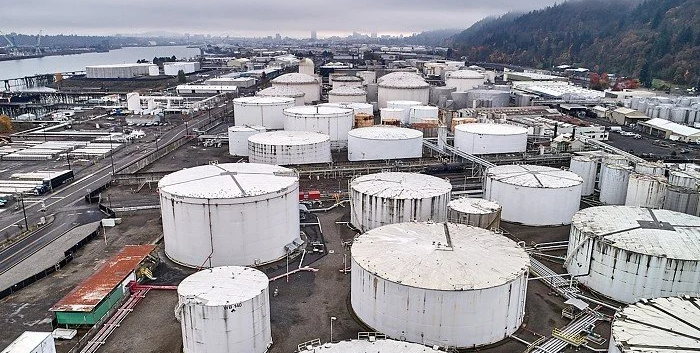
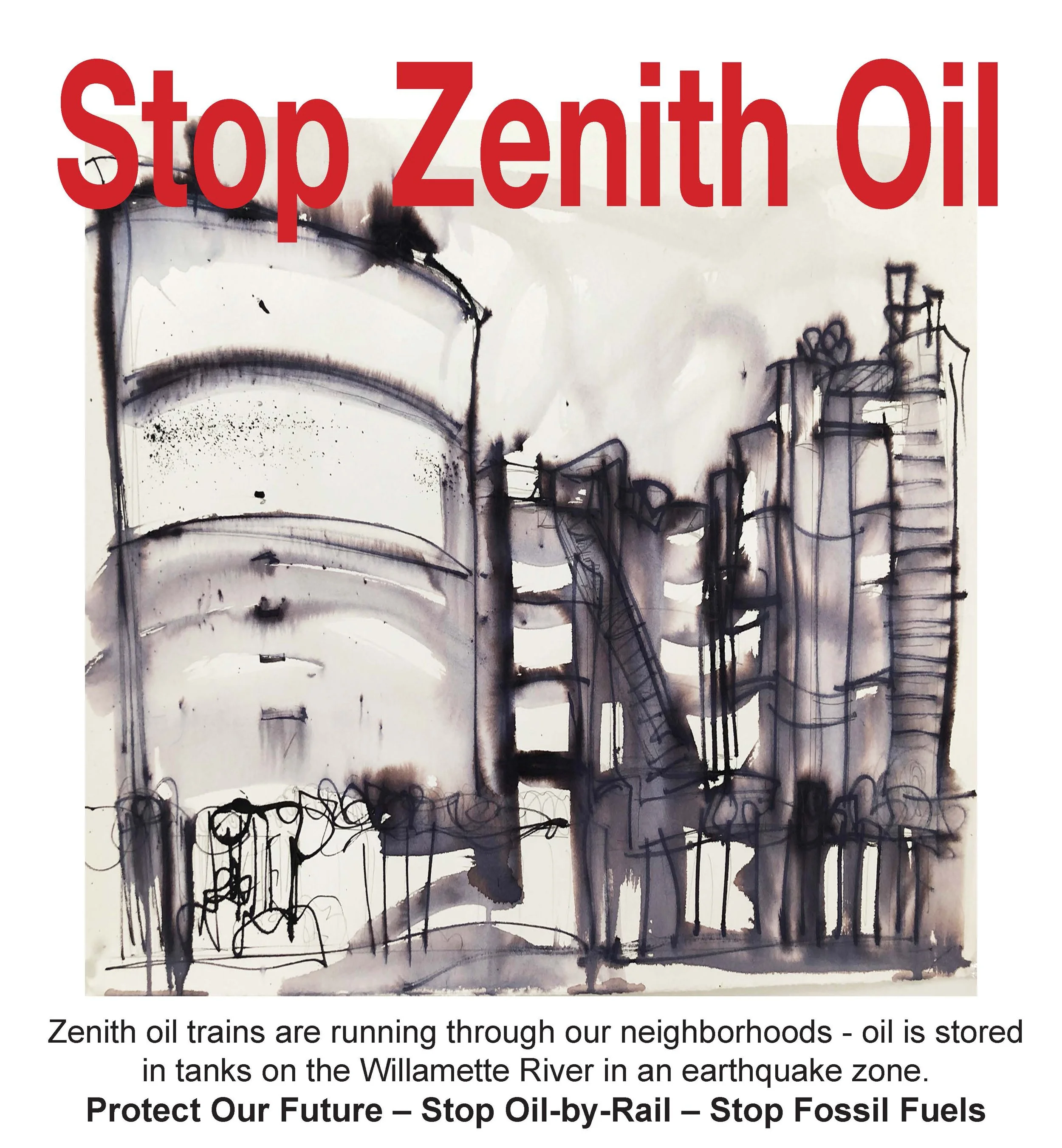
Images: Aerial view of CEI Hub tanks (top; Photo courtesy of Physicians for Social Responsibility. Stop Zenith Oil poster (bottom; credit Linda Wysong).
Why it Matters to Kenton
Kenton sits on the Columbia Slough with the Columbia River to the north and Willamette River to the south. We are an historic working community with two main railroad lines, an Interstate highway, and industry within our borders. It is imperative that safety and public health are the highest priority. The damage from a tanker explosion or earthquake would be enormous. This matters to every woman, man and child in Kenton.
Neighborhood Position
Both the CEI Hub and the explosive trains that supply the facility are concerns beyond the scope of a neighborhood association. The KNA Board has voted to join with other communities and environmental organizations supporting the Rumble on the River Community Forums. We work to educate our neighbors and advocate for healthy policies to our city, county, and state representatives. You can contact our Portland City Councilors and check out our newsletter for opportunities to get involved.
Health and Livability Concerns
-
In 2022, Multnomah County completed a Seismic Risk Analysis of the site. It states that the CEI Hub is on unstable soil subject to liquefaction and lateral spreading in an earthquake, and that there is an estimated 26% likelihood of a major seismic event in the next 50 years. A Cascadia Subduction Zone (CSZ) Earthquake could result in a spill the size of the BP Deepwater Horizon oil spill disaster in the Gulf of Mexico that was the country's largest oil spill to date. This release could easily ignite forest Park and spread to the mouth of the Columbia River.
-
The monetized costs could range up to $2.6 billion. Based on prior spills, total costs and damages would likely be many multiples of the monetized amount.
-
The “Big Quake” is in the possible future, but the trains supplying the liquid fuel present an immediate danger. The 2016 Mosier, Oregon, derailment of a 96-car train where 18 tank cars exploded was the result of one broken bolt. There are about 3 U.S. train derailments per day (National Public Radio, OPB. March 9, 2023). We are in danger daily.
-
In addition to historic and potential catastrophic accidents, the community needs to work toward mitigating climate change and the impacts of global warming. The Heat Dome of 2021 resulted in multiple deaths.
-
Once a Braided River - Documentary by Barbara Bernstein that traces the transformation of the Willamette River from a free-flowing river to a polluted industrial zone. (53 minutes)
Stop the Spill - Video, media package by Julia Bonnheim for Re:Solve NW. (3 ½ minutes)
Latest News